Description
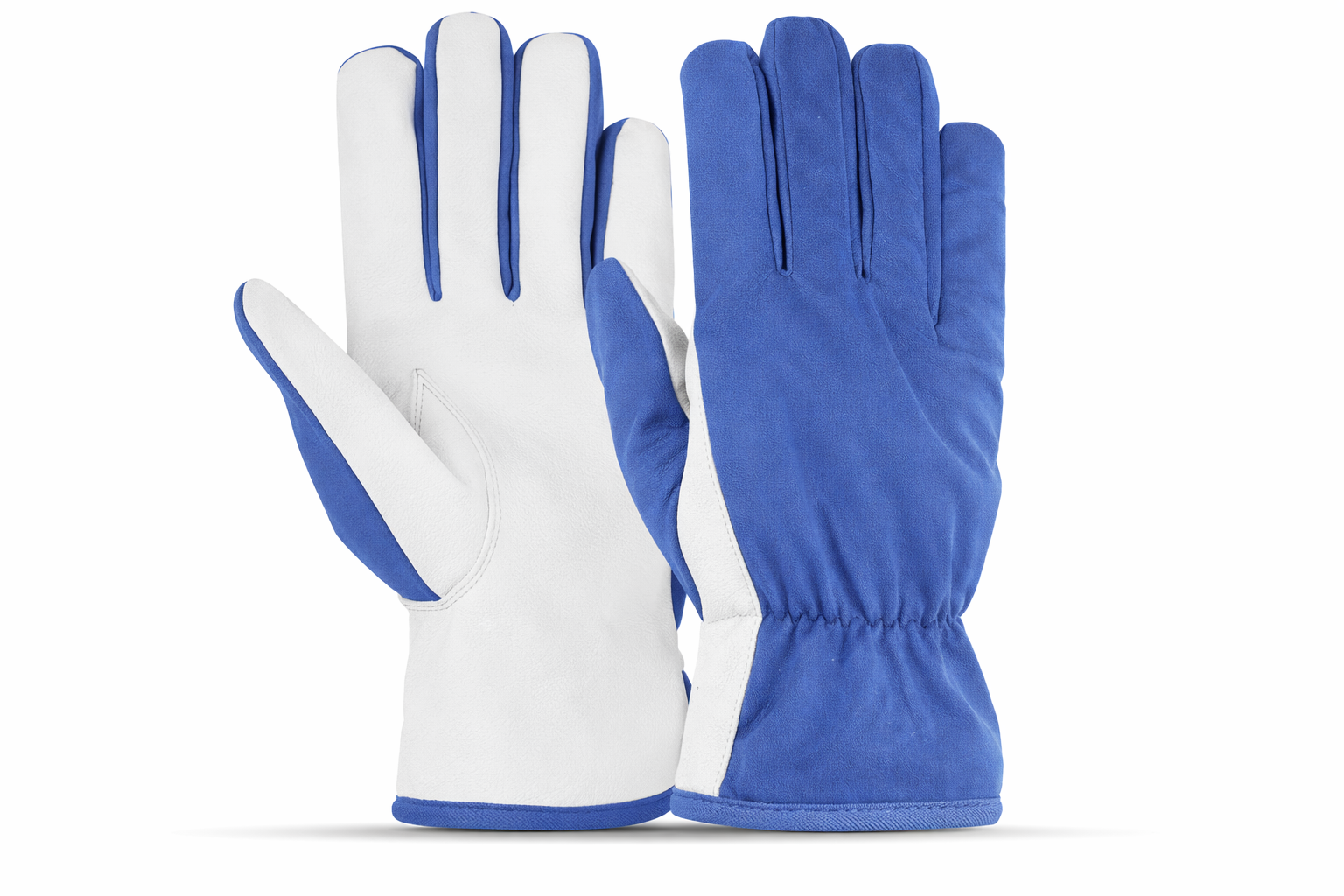
Goatskin Leather Palm Work Gloves with Royal Blue Polyester Back
Goatskin leather palm work gloves are designed for workers who need a practical balance of hand protection, comfort, flexibility, grip, and finger dexterity during everyday manual tasks. This premium style combines a white grain goatskin leather palm with a royal blue polyester fabric back and matching blue polyester border piping, creating versatile leather palm work gloves for mechanics, automotive technicians, warehouse teams, maintenance workers, contractors, agricultural users, and general material-handling applications. The soft goatskin palm is valued for its supple feel and natural flexibility, helping users handle tools, components, cartons, equipment, and work materials without the bulky sensation of some heavier gloves. The polyester back supports freedom of movement and can provide a lighter, more comfortable construction, while the shirred elastic wrist helps keep dirt, dust, and debris from entering around the cuff. These goatskin leather work gloves are especially useful when users need dexterity for turning tools, aligning parts, scanning packages, lifting goods, performing light assembly, or completing routine maintenance. They can also be considered as goatskin mechanic gloves, leather driving gloves, general purpose work gloves, warehouse gloves, utility gloves, and industrial hand protection when their documented performance matches the task. For buyers, importers, distributors, safety-equipment companies, and end users, the key advantage is the combination of a durable-looking grain leather palm, flexible textile back, comfortable wrist closure, and professional appearance. However, glove material and appearance alone do not establish a specific safety rating. In the European Union, protective gloves marketed as PPE must meet the applicable requirements of Regulation (EU) 2016/425 and relevant conformity procedures, while in the United States employers must select hand protection through workplace hazard assessment and match glove performance to the task, conditions, duration, and identified hazards. Therefore, these gloves should not be described as cut-resistant, puncture-resistant, chemical-resistant, heat-resistant, electrical-insulating, impact-rated, CE-certified the exact glove has been appropriately tested and the required documentation supports those claims. Proper sizing, inspection, user training, maintenance, and replacement are also important for effective workplace hand protection. For procurement teams, verified test reports and instructions make it easier to select, document, and safely deploy appropriate hand protection.
Premium Goatskin Leather Palm Work Gloves for Comfort, Dexterity and Everyday Handling
Choosing the right work glove is not simply about selecting the thickest or heaviest material available. In many workplaces, employees need to move their hands continuously, hold tools, manipulate small components, pick up packages, operate equipment, or perform repetitive manual tasks.
A glove that is excessively bulky can make these activities more difficult. Workers may experience reduced finger movement, poor tactile feedback, or discomfort during extended use. As a result, there is often a need for a glove that combines practical hand coverage with flexibility and a comfortable fit.
These goatskin leather work gloves are designed around that requirement.
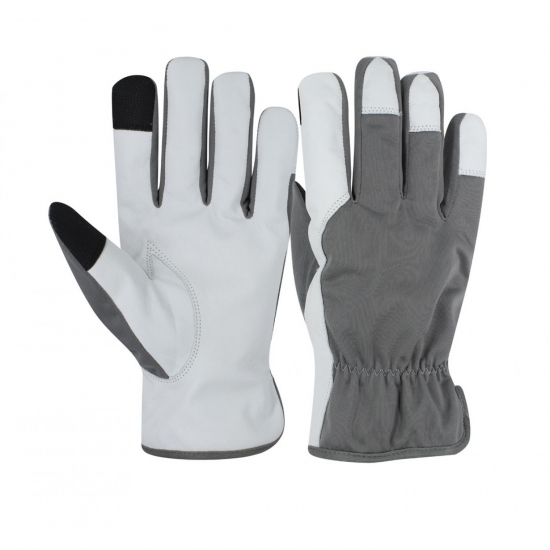
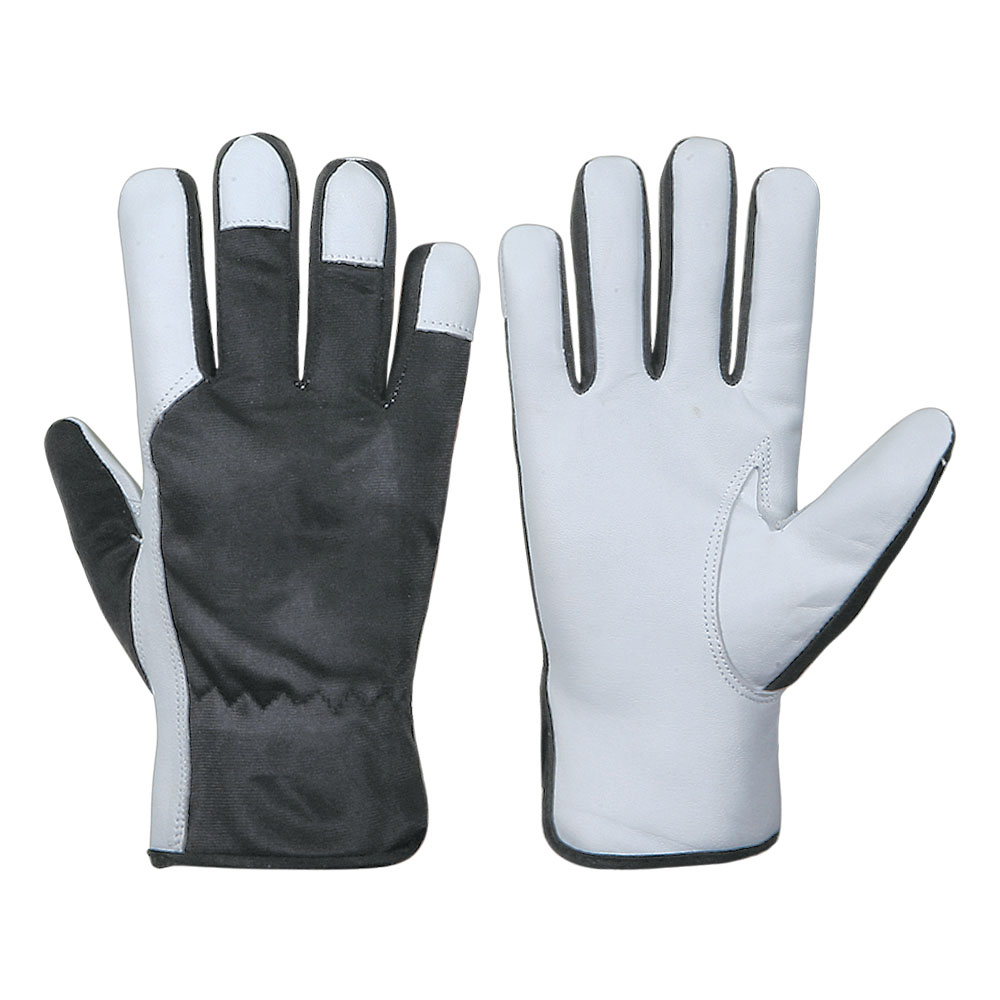
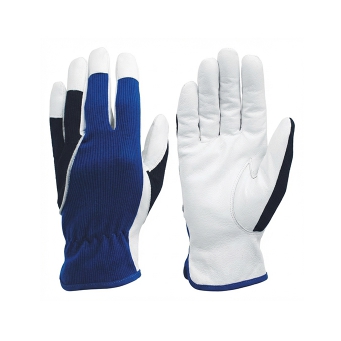
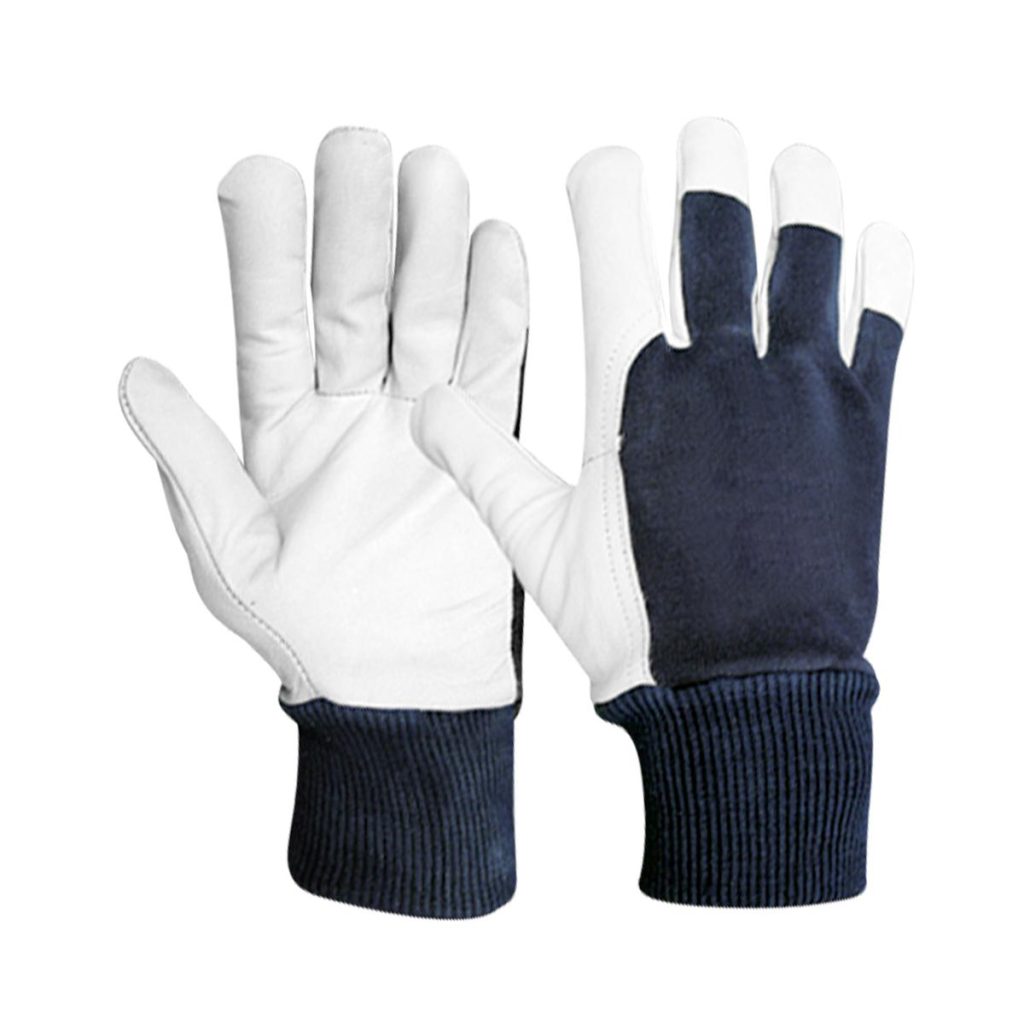
The glove features a white grain goatskin leather palm, a royal blue polyester fabric back, and a blue polyester border piping around the cuff. The contrasting construction gives the glove a professional appearance while providing a useful combination of leather hand protection and flexible textile construction.
The shirred elastic wrist helps create a closer fit around the wrist and helps reduce the entry of ordinary dirt, dust, and debris during general handling work.
For professional buyers, this combination makes the glove suitable for consideration across several industries, including automotive, mechanical maintenance, warehousing, logistics, agriculture, construction support, utilities, light assembly, workshops, and general material handling.
Key Features at a Glance
- Premium white grain goatskin leather palm
- Royal blue polyester fabric back
- Matching blue polyester border piping
- Shirred elastic wrist
- Flexible construction
- High-dexterity glove design
- Comfortable leather palm
- Professional two-color appearance
- Suitable for general-purpose work applications
- Useful for mechanics and automotive handling
- Suitable for light assembly and warehouse tasks
- Suitable for maintenance and utility applications
- Suitable for agricultural and yard work when appropriate for the hazard
- Available for wholesale and commercial procurement
- Suitable for private-label programs subject to manufacturer specifications
Why Choose Goatskin Leather Palm Work Gloves?
Goatskin is a popular leather choice for gloves where flexibility and hand movement are important.
Compared with some heavier leather constructions, goatskin can provide a softer, more supple feel. This characteristic can be useful when workers need to repeatedly flex their fingers or maintain a controlled grip on tools and materials.
The leather palm is also well suited to everyday handling applications because it provides a physical barrier between the worker’s hand and the objects being handled.
However, buyers should understand an important distinction:
Leather type is not the same thing as a safety performance rating.
The fact that a glove is made from goatskin does not automatically mean it has a particular abrasion, cut, tear, puncture, chemical, thermal, impact, or electrical rating.
Those performance claims must be supported by appropriate testing.
This distinction is particularly important for companies purchasing work gloves for regulated industrial applications.
White Grain Goatskin Leather Palm
The white grain goatskin palm is the primary hand-contact area of the glove.
A grain leather surface can provide a clean and professional appearance while retaining the natural characteristics of leather. Goatskin is commonly selected for glove applications where flexibility, comfort, and tactile handling are important.
The white palm also provides a visible contrast against the royal blue polyester back.
From a product-positioning perspective, this makes the glove attractive to buyers looking for white leather palm work gloves, goatskin mechanic gloves, leather palm utility gloves, and premium general-purpose work gloves.
For end users, the main practical advantage is the combination of leather contact with a flexible glove pattern.
Royal Blue Polyester Fabric Back
The back of the glove uses royal blue polyester fabric.
The textile back complements the goatskin palm and helps create a more flexible construction than an entirely leather glove.
This is especially useful for workers who spend long periods moving their hands.
A flexible back can help the glove conform more naturally to hand movement during tasks such as:
- Handling packages
- Picking and sorting products
- Operating hand tools
- Moving equipment
- Light assembly
- Workshop maintenance
- Loading and unloading
- Agricultural handling
- General utility work
The blue textile back also gives the glove a distinctive professional appearance that can work well for branded workwear programs.
Shirred Elastic Wrist
The glove includes a shirred elastic wrist.
This feature is important because the wrist area can affect both comfort and practicality.
A properly fitted elastic wrist can help keep the glove positioned on the hand during movement. It can also help limit the entry of ordinary dust, dirt, and debris around the cuff.
The elastic wrist makes the glove easier to put on and remove than some gloves requiring complicated fastening systems.
For repetitive work, simple glove design can be a significant practical benefit.
Blue Polyester Border Piping
The blue polyester border piping provides a finished edge around the cuff.
Besides contributing to the glove’s appearance, properly constructed border piping can help create a neat cuff finish and support the overall construction of the glove.
For wholesale buyers and private-label customers, the contrasting border also provides an opportunity for coordinated branding and color identification.
High-Dexterity Work Glove Design
One of the strongest selling points of this glove is dexterity.
Workers frequently need to perform tasks that require more than simply holding large objects.
For example, a mechanic may need to turn a wrench, position a component, hold a fastener, or adjust a small part.
A warehouse worker may need to scan a barcode, open packaging, move cartons, or operate a handheld device.
A maintenance worker may need to manipulate fittings, tools, screws, cables, or equipment.
A flexible goatskin palm can be useful for these situations because it allows the user to maintain hand movement without the unnecessary bulk associated with some heavy-duty glove designs.
Applications of Goatskin Leather Palm Work Gloves
Mechanics and Automotive Work
These gloves are particularly suitable for consideration in automotive and mechanical environments where workers require flexible hand protection for routine handling.
Mechanics can use suitable leather work gloves for tasks involving:
- Hand tools
- Wrenches
- Workshop equipment
- Automotive components
- General maintenance
- Parts handling
- Equipment inspection
- Material movement
The gloves can help workers maintain a comfortable grip while reducing direct contact between the hands and rough or dirty surfaces.
However, users should select specialized gloves when working with chemicals, fuels, hot components, welding operations, sharp cutting hazards, or electrical hazards.
Light Assembly
Light assembly work frequently requires excellent hand movement.
Workers may need to repeatedly pick up small components, position parts, move products between workstations, or package finished goods.
A flexible leather palm combined with a textile back can be a practical choice for suitable assembly environments.
The glove should still be evaluated against the actual workplace hazards before being specified as PPE.
Warehousing and Logistics
Warehouse employees may handle boxes, pallets, packaging, equipment, scanners, containers, and other goods throughout a shift.
These activities can expose hands to ordinary abrasion, rough surfaces, dirt, friction, and repetitive handling.
A flexible leather palm glove can be considered for these applications where the documented performance is adequate.
The elastic wrist can also be helpful in environments where workers want to reduce the entry of loose dust and debris.
General Maintenance
Maintenance workers frequently perform diverse tasks rather than one repetitive operation.
They may inspect equipment, move components, operate tools, repair fixtures, or perform routine building maintenance.
This is an area where a comfortable general-purpose glove can be useful.
Potential applications include:
- Building maintenance
- Workshop work
- Equipment servicing
- General handyman work
- Plumbing support tasks
- HVAC maintenance
- Utility work
- Facility maintenance
For specialized electrical tasks, workers must use appropriate electrical protective equipment rather than assuming that a leather work glove provides electrical insulation.
Agriculture and Yard Work
Agricultural and yard-work users often need gloves for routine handling of tools, fencing materials, equipment, containers, and vegetation.
Goatskin leather gloves can be considered for suitable general-purpose applications where their documented performance matches the hazards.
For chainsaw operation, pesticide handling, high-heat work, or severe puncture/cut hazards, specialized protective gloves are required.
Construction Support
These gloves can be considered for general construction handling activities such as moving materials, handling tools, carrying equipment, and routine site work.
Construction environments can contain multiple hazards, however.
A worker may encounter sharp metal, nails, blades, power tools, chemicals, hot surfaces, electrical hazards, and impact hazards.
Therefore, these gloves should not automatically be marketed as universal construction safety gloves.
The correct approach is to match the glove to the specific task and verified performance.
What Problems Do These Gloves Solve?
A good work glove should solve a real workplace problem.
This glove is designed around several common problems faced by workers.
Problem 1: Bulky Gloves Reduce Dexterity
Workers often remove gloves when they need to perform detailed tasks.
That can expose their hands to unnecessary hazards.
A flexible goatskin construction can help maintain dexterity for suitable tasks.
Problem 2: Gloves Move Around During Work
A loose cuff can be uncomfortable and distracting.
The shirred elastic wrist helps create a more secure fit around the wrist.
Problem 3: Dirt Enters Through the Cuff
The elastic wrist can help reduce the entry of ordinary dirt and debris around the wrist area.
It is not a sealed barrier and should not be marketed as protection against liquids, chemicals, or hazardous substances without appropriate testing.
Problem 4: Heavy Gloves Become Uncomfortable
A polyester fabric back can help reduce the bulk associated with full-leather construction.
This can make the glove attractive for repetitive manual work.
Problem 5: Workers Need Professional-Looking Workwear
The white leather palm and royal blue fabric back create a clean, recognizable appearance.
This can be particularly useful for companies operating branded workwear programs.
Why the White and Blue Color Combination Works
The white grain leather palm gives the glove a clean, professional appearance.
The royal blue polyester back provides a strong visual contrast.
The matching blue border piping creates a coordinated finish around the wrist.
This appearance can be particularly useful for companies that want employees to have a consistent professional workwear identity.
For wholesalers, the recognizable color combination can also help differentiate the product from generic brown or all-leather work gloves.
Wholesale Goatskin Leather Palm Work Gloves
These gloves can be positioned for wholesale buyers, distributors, importers, safety-equipment companies, hardware retailers, workwear suppliers, and industrial procurement programs.
Wholesale customers may be interested in:
- Bulk quantities
- Multiple sizes
- Private labeling
- Custom packaging
- Custom hang tags
- Company logos
- Carton labeling
- Size assortments
- Customized colors
- Retail packaging
- Industrial packaging
Actual customization options, minimum order quantities, production capacity, and lead times should be confirmed by the manufacturer.
Private Label Opportunities
The design is also suitable for private-label positioning.
A brand can market the glove under its own product family while retaining the core construction:
White grain goatskin palm + royal blue polyester back + elastic wrist + blue border piping.
For private-label customers, the most important consideration is consistency.
The supplier should maintain:
- Consistent leather quality
- Consistent sizing
- Consistent stitching
- Consistent color
- Consistent polyester construction
- Consistent packaging
- Consistent product identification
For regulated PPE, changes to the glove construction may also affect the applicability of test reports and conformity documentation. Buyers should therefore avoid assuming that a test report for one glove configuration automatically applies to a modified model.
Product Specification Table
| Product Feature | Description |
|---|---|
| Product Type | Goatskin Leather Palm Work Gloves |
| Palm Material | White Grain Goatskin Leather |
| Back Material | Royal Blue Polyester Fabric |
| Border | Blue Polyester Border Piping |
| Wrist | Shirred Elastic Wrist |
| Construction | Leather Palm with Textile Back |
| Primary Benefit | Flexibility and Dexterity |
| Intended Positioning | General-Purpose Work Glove |
| Suitable Applications | Mechanics, Maintenance, Handling, Warehouse, Agriculture, Utility Work |
| Sizes | Subject to Manufacturer Specification |
| Color | White / Royal Blue |
| Branding | Subject to MOQ and Supplier Capability |
| Packaging | Wholesale / Retail Options |
Frequently Asked Questions
1. What are goatskin leather palm work gloves?
Goatskin leather work gloves are work gloves made with goatskin leather, often selected for its soft feel, flexibility, and suitability for tasks requiring hand movement and dexterity.
2. What are these gloves made from?
This model features a white grain goatskin leather palm, royal blue polyester fabric back, blue polyester border piping, and a shirred elastic wrist.
3. Are goatskin gloves flexible?
Goatskin is generally valued for its supple and flexible characteristics, making it a popular material for gloves where dexterity and comfortable hand movement are important.
4. Are these gloves good for mechanics?
They can be suitable for general automotive and mechanical handling tasks where their documented performance matches the hazards involved. They should not automatically be used for chemical, electrical, high-temperature, welding, severe-cut, or other specialized hazards.
5. Are these gloves suitable for warehouse work?
They can be considered for general material handling, packaging, sorting, loading, scanning, and other suitable warehouse tasks.
6. Are these goatskin gloves waterproof?
Do not assume that standard goatskin work gloves are waterproof. Waterproof performance should only be claimed when supported by the manufacturer’s specification or appropriate testing.
7. Are these gloves cut resistant?
Not automatically. Cut resistance must be demonstrated through appropriate testing of the exact glove configuration.
8. Are these gloves puncture resistant?
Not automatically. A leather palm does not by itself establish a specific puncture-resistance classification.
9. Are these gloves chemical resistant?
Standard goatskin work gloves should not be marketed as chemical-resistant unless they have been specifically designed and tested for the relevant chemical exposure.
10. Can these gloves be used for electrical work?
A general-purpose goatskin glove should not be treated as an electrical insulating glove. Electrical work requires appropriate electrical protective equipment.
11. Do these gloves meet EN 388?
Only state EN 388 performance if the exact glove has been tested and the applicable test report supports the claim.
12. Do these gloves meet EN ISO 21420?
The applicable conformity statement depends on the actual product, testing, and regulatory documentation. ISO 21420:2020 establishes general protective-glove requirements and is not a standalone protective-performance rating.
13. Are these gloves CE certified?
Do not claim CE certification unless the exact product has completed the applicable EU conformity assessment and the required documentation is available. Regulation (EU) 2016/425 establishes the EU PPE framework, including conformity assessment, Declaration of Conformity, CE marking, and manufacturer/importer obligations.
14. Are these gloves OSHA approved?
The phrase “OSHA approved” should not be used as a blanket product claim. OSHA requires employers to assess workplace hazards and select suitable PPE based on the task, conditions, duration, and hazards identified.
15. What is ANSI/ISEA 105?
ANSI/ISEA 105 is an American National Standard used to classify and test hand and arm protection for various performance properties. The current edition is ANSI/ISEA 105-2024.
16. Are these gloves suitable for construction?
They may be suitable for appropriate general construction and material-handling tasks, but construction hazards vary significantly. Specialized protection should be used where the task involves severe cuts, punctures, impact, chemicals, heat, electricity, or other specific hazards.
17. Are these gloves suitable for agricultural work?
They may be suitable for general agricultural and yard tasks such as routine handling, tool use, fencing, and material movement when the glove’s performance matches the hazard.
18. Are these gloves suitable for light assembly?
Yes, they can be considered for suitable light assembly applications where flexibility and hand movement are important.
19. Do the gloves have an elastic wrist?
Yes. The described construction includes a shirred elastic wrist designed to provide a closer wrist fit and help reduce ordinary dirt and debris from entering the cuff.
20. Can these gloves be purchased wholesale?
Yes, they can be positioned for wholesale procurement, subject to manufacturer MOQ, available sizes, packaging requirements, production capacity, and customization options.
21. Can the gloves be private labeled?
Private labeling may be available depending on the manufacturer’s capabilities. Options can include logos, packaging, hang tags, labels, colors, and carton markings.
22. How should employers select these gloves?
Employers should begin with a workplace hazard assessment and identify the type and severity of hazards, required dexterity, working conditions, duration of exposure, and required glove performance. OSHA specifically requires workplace hazard assessment and appropriate PPE selection in covered workplaces.
23. What documentation should a professional buyer request?
Depending on the intended market and application, buyers should request material specifications, product identification, test reports, applicable conformity documentation, instructions, labeling information, and evidence supporting any claimed protective performance.
24. How should users inspect these gloves?
Users should check for tears, holes, damaged stitching, excessive abrasion, damaged leather, damaged fabric, damaged elastic, contamination, or any other condition that could compromise safe use.
25. When should work gloves be replaced?
Gloves should be replaced when they become damaged, excessively worn, contaminated, or otherwise unsuitable for the intended task. OSHA states that defective or damaged PPE should not be used.
Buyer Guide: How to Purchase the Right Goatskin Leather Palm Work Gloves
For buyers purchasing hundreds or thousands of pairs, price should not be the only purchasing criterion.
A low-cost glove can become expensive if workers frequently replace it, if sizing is inconsistent, or if the glove does not provide the performance required for the task.
1. Confirm the Material
Request confirmation that the palm is actually goatskin leather and clarify the leather grade and construction.
2. Confirm the Back Fabric
The back should be specified as polyester fabric according to the agreed product specification.
3. Check the Stitching
Examine seam consistency, thread quality, reinforcement, and the attachment between the leather and textile sections.
4. Check the Wrist
The shirred elastic should provide a consistent fit without excessive looseness or uncomfortable compression.
5. Confirm Sizes
Request a size chart and production measurements.
6. Request Samples
Before committing to a large order, professional buyers should evaluate samples for:
- Fit
- Dexterity
- Stitching
- Leather quality
- Color
- Comfort
- Wrist construction
- General durability
7. Verify Safety Claims
If the supplier claims EN, ISO, ANSI, or other performance ratings, request the actual report for the exact glove model.
8. Confirm Market Requirements
EU buyers should verify Regulation (EU) 2016/425 requirements where applicable.
U.S. workplace buyers should evaluate the glove against the employer’s OSHA hazard assessment requirements.
Final Conclusion
These goatskin leather palm work gloves provide a practical combination of a white grain goatskin leather palm, royal blue polyester fabric back, shirred elastic wrist, and blue polyester border piping. The design is especially attractive for users who value flexibility, comfort, dexterity, and a professional appearance during general-purpose manual work.
The goatskin leather palm gives the glove its distinctive premium feel and flexible handling characteristics, while the polyester back supports a lighter and more flexible glove construction. The elastic wrist helps keep the glove positioned during movement and can reduce the entry of ordinary dirt and debris around the cuff.
For mechanics, automotive technicians, warehouse employees, maintenance workers, agricultural users, contractors, utility workers, and general material handlers, this type of glove can be a practical choice when its characteristics match the specific workplace hazards.
For buyers and distributors, however, the most important point is that material and appearance do not establish a safety rating.
A goatskin leather glove should not automatically be described as cut-resistant, puncture-resistant, chemical-resistant, heat-resistant, impact-rated, electrical-insulating, waterproof, CE-certified, or OSHA-approved.
In the European Union, where the product falls within the PPE framework, Regulation (EU) 2016/425 establishes requirements relating to essential health and safety requirements, conformity assessment, CE marking, technical documentation, instructions, and economic-operator responsibilities.
For workplace use in the EU, employers must also assess risks and select PPE appropriate to the hazards, conditions, ergonomics, and fit.
In the United States, OSHA requires employers to conduct appropriate workplace hazard assessments and select hand protection according to the hazards, task, conditions, duration of use, and glove performance characteristics.
For U.S. buyers looking for standardized performance classification, ANSI/ISEA 105-2024 provides a current framework for classification and testing of hand and arm protection across several performance properties.
The strongest commercial strategy is therefore to sell these gloves on their verified strengths: goatskin leather construction, flexibility, dexterity, comfortable wrist fit, practical textile back, professional appearance, and suitability for appropriate general-purpose applications.
For an e-commerce website, combine this long-form content with original product photography, a clear size chart, technical specifications, verified test reports where applicable, transparent compliance information, purchasing details, genuine customer reviews, internal links to related glove products, and structured product information.
That approach gives potential customers the information they need to make a better purchasing decision while also creating a strong topical foundation around goatskin leather palm work gloves, goatskin mechanic gloves, leather palm work gloves, high-dexterity gloves, blue polyester back work gloves, general-purpose work gloves, and industrial hand protection.
Most importantly, the product page should always distinguish between what the glove is made of, what it is designed for, and what it has actually been tested to protect against. That distinction builds buyer confidence, reduces misleading claims, supports professional procurement, and creates a more trustworthy product page for both search engines and real-world end users.